
Which Segments in the Cannabis Market Are Creating Demand for Filling Equipment
Many people still associate the cannabis market with cultivation, raw materials, and retail sales. But the real shift in this market is no longer just about how much product is sold. It is also about how cannabis is processed and turned into finished products. In recent years, extracts, vapor products, and formulated products have taken up a larger share of the market. This shows that the cannabis industry is moving away from a raw-material-driven model and toward a manufacturing-driven one. As product formats continue to evolve, production priorities are changing as well. Filling is one of the less visible parts of this shift, but its importance is growing.
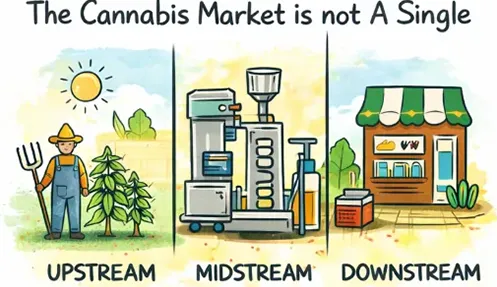
The Cannabis Market is not A Single Market
The cannabis market is more than a simple consumer market. It is a regulated industry chain made up of several licensed stages. Upstream activities include raw materials and cultivation. Midstream activities include extraction, refining, filling, packaging, and product manufacturing. Downstream activities include branding, distribution, and retail. This structure is especially important in segments such as extracts, vapor products, and liquid products, where filling equipment can have a direct impact on output, yield, and delivery performance.
Extracts and the Cannabis Manufacturing Market
The cannabis market is not only expanding in size. Its product mix is also changing. One of the clearest developments is the continued growth of extract-related products. In Canada, inhaled extracts reached about CAD 1.719 billion in fiscal year 2024/2025. They accounted for 31.1% of total recreational cannabis sales and remained the fastest-growing product category. At the same time, ingested extracts reached about CAD 170 million. This suggests that extracts are no longer just an extension of raw cannabis consumption. They are becoming a central part of the legal cannabis market.
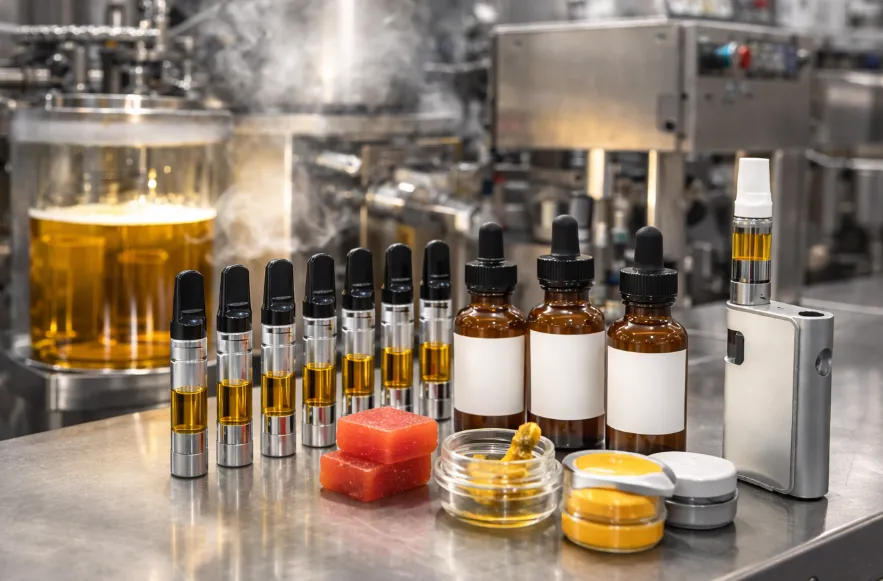
As this trend continues, the market is moving further away from traditional raw material consumption. More value is now concentrated in extraction, formulation, and finished-product manufacturing. Products such as concentrates, tinctures, vape cartridges, and integrated vaporizers all fall into this category. They are manufactured products built on cannabis extracts. As these products continue to gain share, the cannabis market is becoming more dependent on deep processing, product segmentation, and manufacturing capability.
Why The Manufacturing Side Needs Cannabis Filling Equipment More
In the legal cannabis market, equipment is no longer used only to improve output. It has also become part of compliant production. Canada’s Good Production Practices, or GPP, makes this clear. Licensed businesses must meet Part 5 requirements. These requirements apply to production, packaging, labeling, distribution, storage, sampling, testing, and sales. This shows that equipment is not just a productivity tool. It also supports standardized production and regulatory compliance.

Consistency becomes even more important as production grows. California regulations set a limit of 150,000 units for a single cannabis product batch or pre-roll batch. They also require minimum sampling levels based on batch size. For example, a batch of 50 units or fewer requires 2 samples. A batch of 35,001 to 150,000 units requires 50 samples. This means that as production scales up, batch stability becomes more critical. It can directly affect testing, product release, and time to market.
This is especially true for extracts and vapor products. Filling accuracy, temperature control, cleaning, batch changeover, and integration with labeling and traceability systems are no longer just technical features. They are part of a stable and compliant manufacturing process. Regulations require companies to complete inventory reconciliation at least once every 30 days. They must also correct system errors within 3 days. In addition, products must go through batch-based sampling and testing. As manufacturing expands, the need for automated and standardized equipment becomes stronger.
Conclusion
The cannabis market is changing in more ways than one. Sales are growing, but the structure of the market is also evolving. More growth is now coming from extracts and manufacturing. Product categories are becoming more specialized, and regulatory requirements are becoming more detailed. At the same time, the need for large-scale and standardized production continues to rise. As a result, the manufacturing side of the cannabis market is becoming increasingly dependent on filling equipment.