
What Is a Vape Cartridge Filling Machine? A Complete Guide
This article explains the main types of vape cartridge filling machines, their core components, key selection factors, and application scenarios to help you choose the most suitable solution for your production needs.
What Is a Vape Cartridge Filling Machine?
A vape cartridge filling machine is a specialized production device designed to accurately dispense viscous oils into vape cartridges in a controlled and repeatable process. It is widely used in modern vape manufacturing environments where consistent filling quality, hygienic handling, and production efficiency are required.
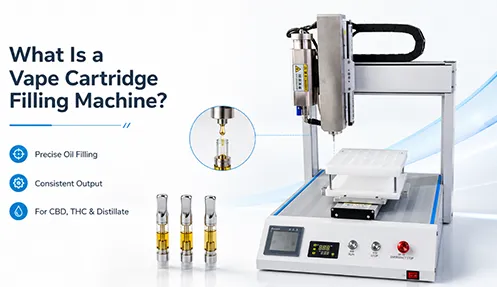
This type of equipment is mainly applied in the production of cartridges filled with CBD oil, THC oil, e-liquid, and other concentrated distillates. Its core purpose is to ensure that each cartridge receives a stable and consistent amount of material during manufacturing, supporting reliable production outcomes in commercial vape manufacturing and OEM/ODM operations.
How Does a Vape Cartridge Filling Machine Work?
A vape cartridge filling machine operates through a coordinated system that manages temperature control, material transfer, and precise dosing to ensure stable and consistent cartridge filling results during production.
1.Heating System
The heating system is responsible for maintaining the oil in an optimal flow state before and during filling. Since many vape oils such as CBD or distillate have high viscosity at room temperature, the vape cartridge filling machine uses a controlled heating tank or heated pipeline to reduce resistance and improve fluidity. This ensures the material can be processed smoothly without clogging or uneven flow, especially in continuous production environments.
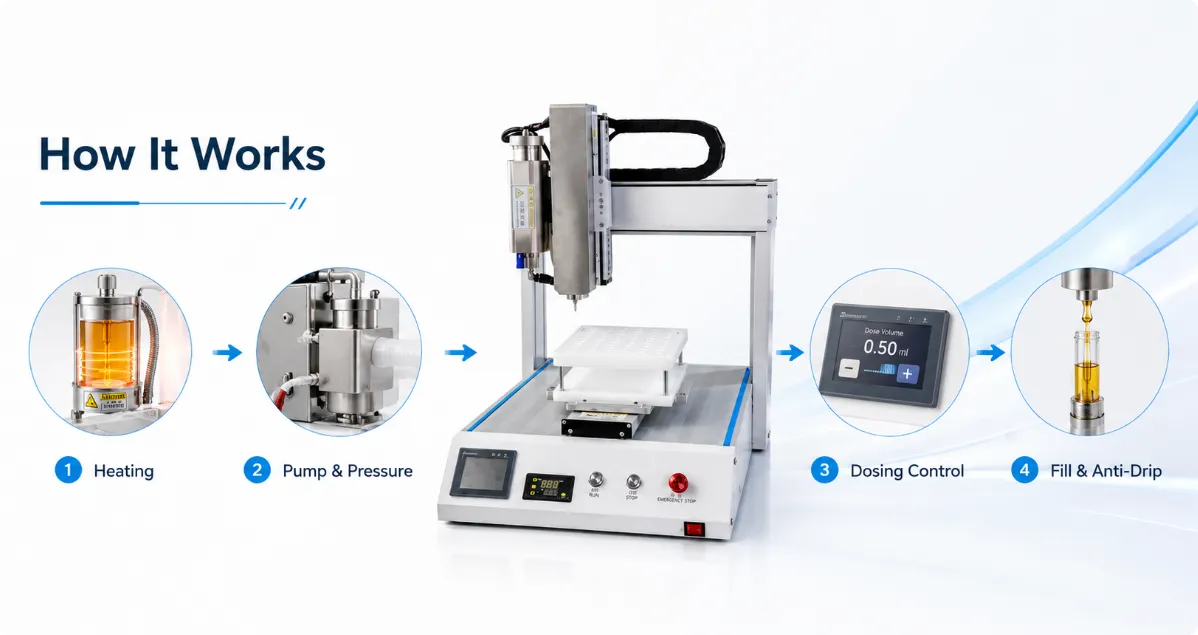
2.Pumping & Pressure System
The pumping and pressure system is the core driving force of the vape cartridge filling machine, responsible for transferring oil from the reservoir to the filling nozzles. Depending on the configuration, it may use gear pumps, peristaltic pumps, or pneumatic pressure systems to maintain a stable and consistent output. This system ensures the material is delivered evenly, even when handling high-viscosity oils or long production cycles.
3.Dosing Control System
The dosing control system manages how much material is dispensed into each vape cartridge. In a vape cartridge filling machine, this is achieved through programmable control of time, pressure, or volume parameters. By precisely regulating each cycle, the system ensures consistent fill levels across all cartridges, typically maintaining high accuracy within tight production tolerances such as ±1% variation depending on setup and oil characteristics.
4.Filling Process Flow
The overall working process of a vape cartridge filling machine follows a continuous production sequence: the oil is first heated to improve flowability, then transferred through the pumping system under controlled pressure, followed by precise metered dispensing into each cartridge. After filling, a brief anti-drip or suction-back action helps prevent leakage and material waste, ensuring clean and stable output before cartridges are collected for the next production stage.
Types of Vape Cartridge Filling Machines
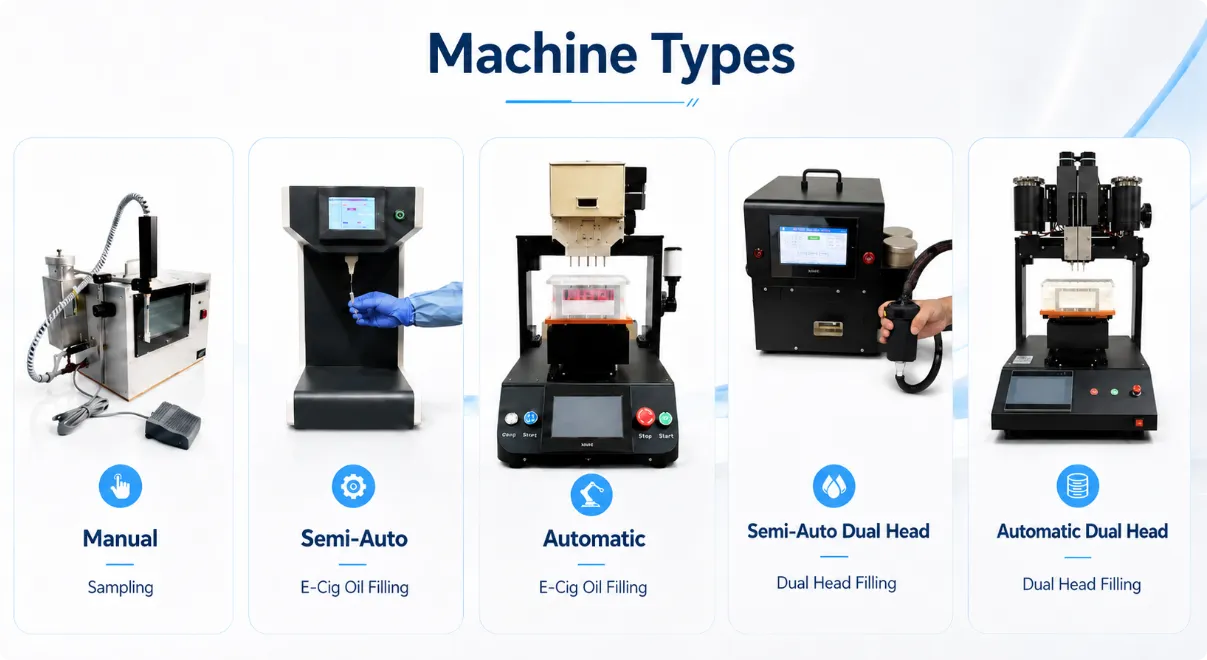
Type | Automation Level | Production Capacity | Heating System | Accuracy | Key Feature | Best For |
Manual Filling Machine | Low | Very low | None / Basic | Low (operator dependent) | Fully manual operation | Sampling / lab testing |
Semi-Automatic Machine (TOP-1 Semi-Auto CBD) | Medium | Small–Medium batch | 0–120°C controlled heating | ±1%–±3% | Heating + precision dosing system | Startup / OEM small batch |
Fully Automatic Machine (TOP-1 Automatic CBD) | High | 800–1500 pcs/hour | 0–120°C integrated heating | ±1% | PLC control + automatic feeding | Mass production |
Medium | Small batch | Dual zone 0–120°C | ±2%–±3% | Dual independent filling channels | R&D / formulation testing | |
Very High | High-volume continuous | Dual independent 0–120°C tanks | ±1% | Dual oil system + full automation | Advanced OEM production |
Key Components of a Cartridge Filling Machine
A vape cartridge filling machine is composed of several core functional modules that are responsible for controlling stability, precision, and mechanical coordination during production. Each component plays a specific role in ensuring repeatable cartridge filling performance.
1.Heating Tank / Reservoir
The heating tank primarily functions as a material conditioning unit, ensuring that oil remains in a processable state before entering the dosing stage. In a vape cartridge filling machine, its role is not to process the entire system, but to maintain consistent material readiness so downstream filling remains stable, especially during continuous production cycles.
2.Filling Nozzles
Filling nozzles are the final interface between the machine and the cartridge. Their main function is to ensure clean and controlled material release at the point of filling. In practical production, their design directly influences filling cleanliness and output consistency, particularly when handling small-volume cartridge formats.
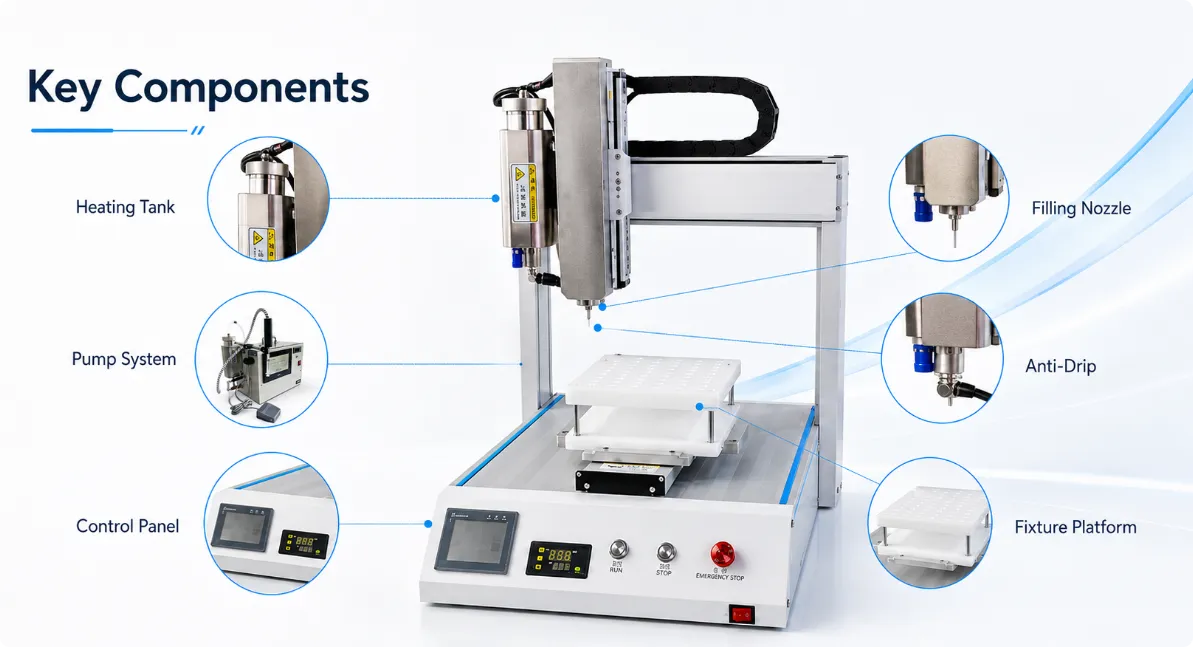
3.Pump System
The pump system is responsible for material transfer within the machine, but its key value lies in maintaining stable delivery rather than simply pushing oil. In different vape cartridge filling machine configurations, pump selection determines how smoothly the system can handle varying viscosities and maintain consistent pressure during operation.
4.Control Panel
The control system functions as the operational coordination layer of the machine. Instead of directly handling physical processes, it defines production logic by managing parameters such as timing, dosage settings, and temperature references. In automated systems, it ensures repeatability across production batches.
5.Anti-Drip System
The anti-drip system is focused on output control at the final stage of each filling cycle. Its main role is to ensure clean separation between consecutive cartridges, preventing residual oil from affecting product appearance or causing material waste after dispensing is completed.
6.Conveyor / Fixture
The conveyor or fixture system provides mechanical positioning stability during operation. Its core function is not transportation speed, but ensuring that each cartridge remains properly aligned with the filling position, supporting consistent operation in both semi-automatic and fully automatic vape cartridge filling machine systems.
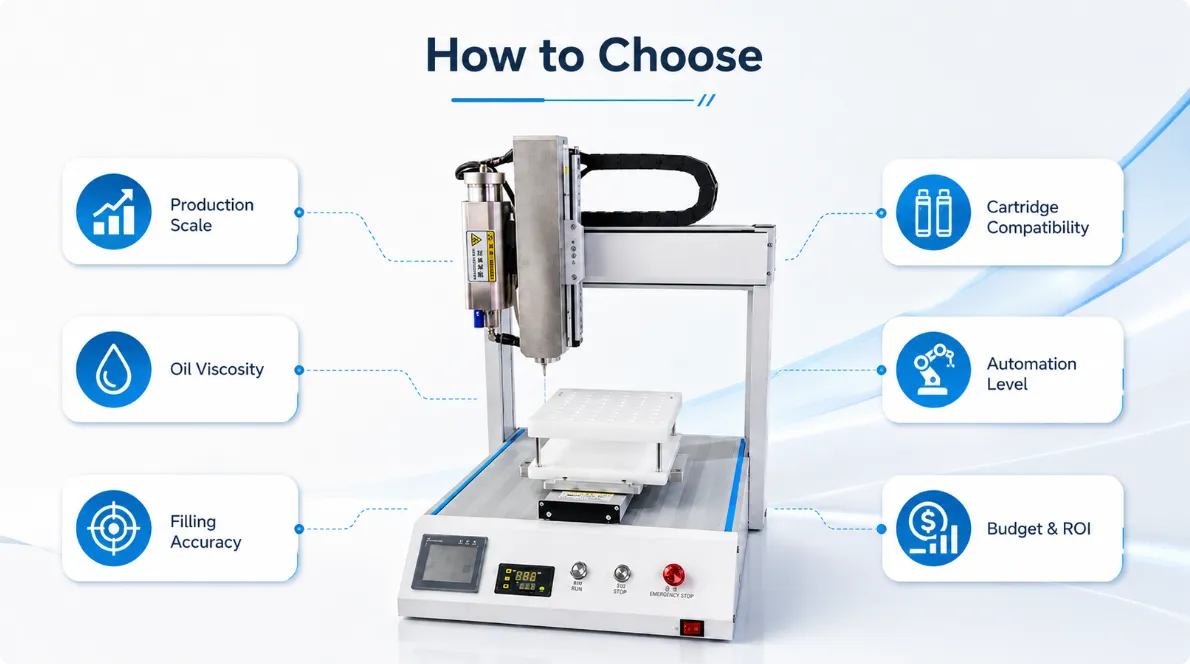
Key Factors When Choosing a Vape Cartridge Filling Machine
Selecting the right vape cartridge filling machine depends on several production-related factors that directly influence output efficiency, product consistency, and long-term manufacturing cost.
1.Production Scale
Production scale is the primary factor that determines the appropriate machine type. Small-scale operations usually prioritize flexibility and lower investment, while medium-scale production requires a balance between efficiency and stability. Large-scale manufacturing environments typically depend on fully automated systems to maintain continuous output and reduce labor dependency. Matching equipment level with production volume is essential to avoid underutilization or capacity limitations.
2.Oil Viscosity
Oil viscosity directly affects how smoothly material can be processed during filling. High-viscosity oils such as rosin, wax, and distillate require stable heating support and consistent pressure control to ensure proper flow. If this factor is not properly considered, it may result in uneven filling or production interruptions, especially in continuous manufacturing environments.
3.Filling Accuracy
Filling accuracy determines product consistency across batches and is particularly important for commercial vape cartridge production. In most industrial applications, maintaining a deviation within ±1% is considered a stable standard. Higher accuracy requirements typically demand more advanced dosing control systems to ensure uniform cartridge output and reduce material waste.
4.Cartridge Type Compatibility
Different cartridge structures require different mechanical and alignment configurations during filling. Common types include 510 cartridges, pod systems, and ceramic or metal cartridges. Compatibility affects how the filling nozzles, fixtures, and positioning systems are designed, making it an important consideration when selecting a vape cartridge filling machine for multi-product production.
5.Automation Level
Automation level defines how much manual intervention is required during production. Some operations only require manual loading, while others demand fully automated feeding, filling, and control systems. Higher automation levels improve consistency and efficiency but also increase system complexity. The right choice depends on production scale and operational workflow requirements.
6.Budget & ROI
Budget is not only about initial equipment cost but also long-term production efficiency and return on investment. Lower-cost systems may be suitable for entry-level production, while higher-end automated machines are better suited for long-term, high-volume manufacturing. Evaluating ROI helps determine whether the investment aligns with expected production growth and operational goals.
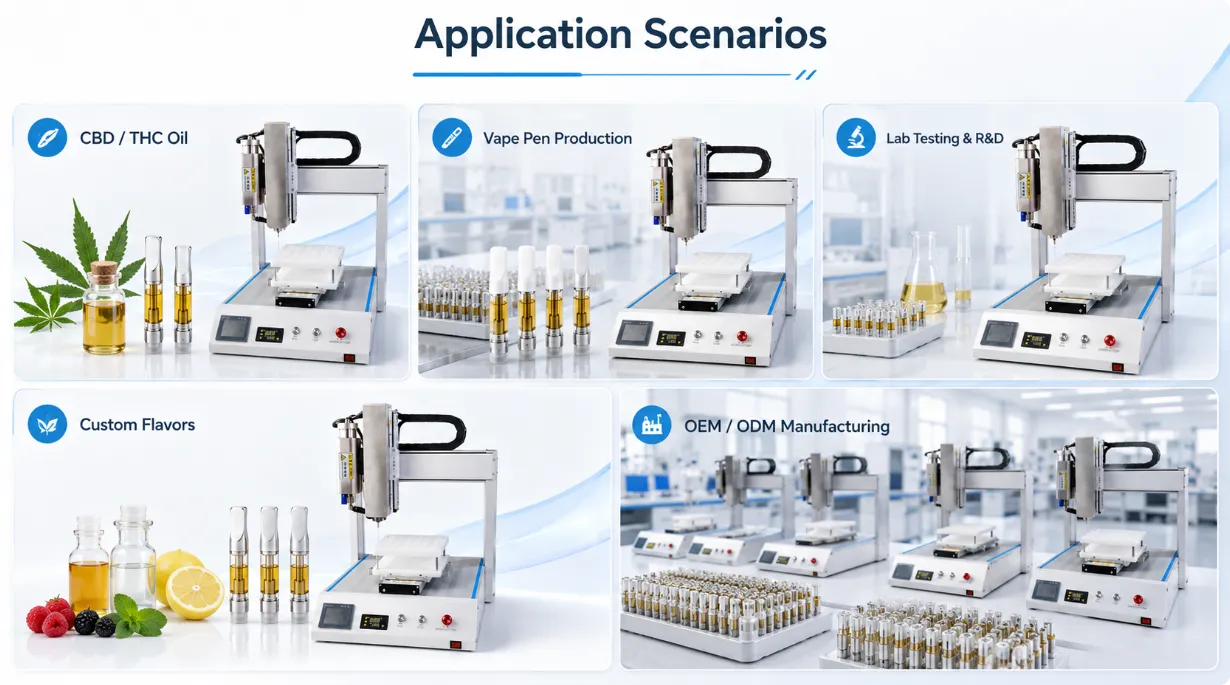
Application Scenarios
The vape cartridge filling machine is widely used across different stages of vape product manufacturing, from early-stage formulation development to large-scale commercial production. Its flexibility makes it suitable for both laboratory environments and industrial production lines.
1.CBD / THC Oil Production
In CBD and THC oil manufacturing environments, the vape cartridge filling machine is primarily used to handle high-viscosity concentrates and ensure stable cartridge filling during continuous production. It supports consistent output quality, making it suitable for regulated production processes where product uniformity is required.
2.Vape Pen Manufacturing
In vape pen production, the filling machine plays a key role in the final stage of cartridge assembly. It ensures that each vape pen cartridge is filled with a consistent amount of material, supporting stable product performance across different production batches.
3.Lab Testing & Formulation R&D
For laboratory and R&D environments, the vape cartridge filling machine is used to test new formulations and evaluate oil behavior under controlled filling conditions. This allows developers to adjust viscosity, flavor ratios, and filling performance before scaling to mass production.
4.Small Batch Custom Flavors
In small-batch production scenarios, manufacturers use the machine to produce customized flavor cartridges for market testing or niche product lines. This application focuses on flexibility and fast changeover between different formulations.
5.OEM / ODM Contract Manufacturing
In OEM and ODM manufacturing environments, the vape cartridge filling machine is used for large-scale contract production where consistency, efficiency, and repeatability are critical. It supports standardized production processes for multiple brands while maintaining stable output quality across different product specifications.
Conclusion
Choosing the right vape cartridge filling machine is a critical decision that directly affects production efficiency, product consistency, and long-term manufacturing cost. From manual systems for early-stage testing to fully automatic industrial production lines, each type of equipment serves a different stage of manufacturing development.
If you are looking for a reliable filling solution or need technical guidance for your production line, contact Longwill Machinery today to get a customized recommendation and professional support for your vape cartridge filling project.